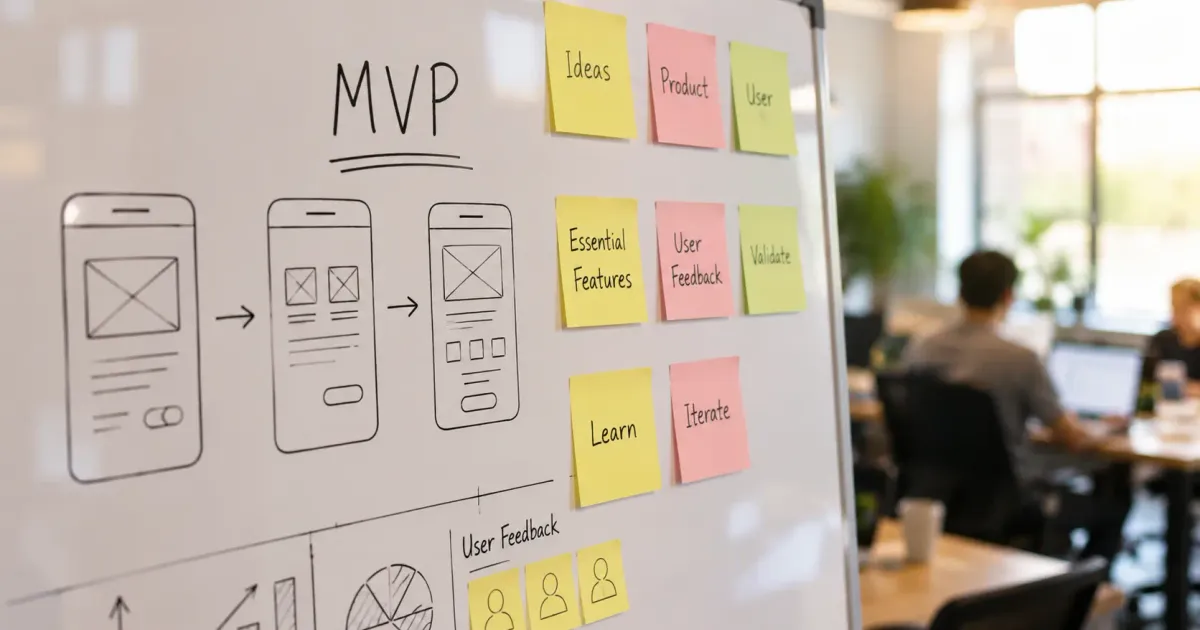
Many startups fail not because their team couldn't build the product, but because they built the wrong product — complete with dozens of features, before knowing whether people actually need it. This is where the MVP (Minimum Viable Product) concept comes in.
Table of Contents
What Is an MVP?
An MVP is the earliest version of a product, containing only its core features — enough to meet users' basic needs and gather real feedback. The term was popularized by Eric Ries through the Lean Startup movement, and has since become the standard approach for almost every tech startup before building a full version of a product.
Why Is an MVP Important?
- Testing whether the market actually needs the product idea, before spending significant time and money
- Getting real feedback from actual users, not the internal team's assumptions
- Minimizing the risk of product failure with far lower development costs
- Speeding up time to market compared to building a complete product from the start
MVP Examples from Startups That Are Now Huge
A few startups that are now tech giants started from a very simple MVP:
- Airbnb — started as just a minimal site with photos of the founders' own apartment, before growing into a global property rental platform
- Dropbox — started with a simple demo video explaining how the product worked, to gauge user interest before the product was actually fully built
- Uber — its earliest version only connected premium black cars in one city, far from the feature complexity it has now
The Most Common Forms of an MVP
1. A Landing Page with an Interest Form
A page that explains the product and collects prospective users' emails — the cheapest way to gauge market interest before building anything.
If you choose this option, a simple landing page in Indonesia is usually quite affordable — see the full price range in our guide on the cost of building a website.
2. A Demo Product / Interactive Prototype
A clickable prototype showing the product's main flow, used to get validation from prospective users or investors without needing a fully functioning backend.
3. A Crowdfunding Project
Offering a product before it's built through a crowdfunding platform — if people are willing to pay upfront, that's an extremely strong market validation signal.
How to Start Building an MVP
- Define one core problem you want to solve — not a long feature list
- Build only the features that directly support that problem, save the rest for the next version
- Release it to a small group of real users as fast as possible
- Collect feedback and measure whether the problem is actually being solved
- Iterate based on data, not assumptions — only add features once there's proof they're needed
Some startups even use AI automation to speed up this early validation process — read examples of it in our article.
When It's Time to Talk to a Development Team
A good MVP still needs the right architecture from the start — so that once the product proves it has market demand, you don't need to rebuild from scratch. If you're planning an MVP for a SaaS product, our team is experienced in helping startups design an MVP that ships fast but still has a foundation to grow on — see the details on our SaaS Development page.



Comments
Got a question or feedback? Leave a comment!