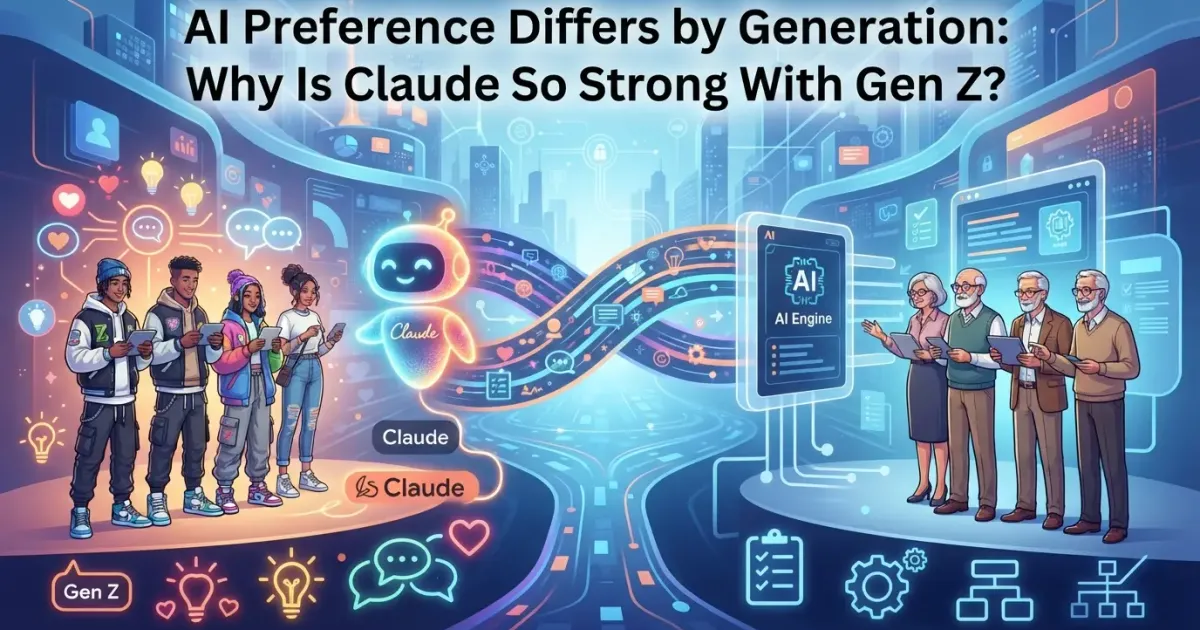
AI preference turns out not to be uniform across generations. New YouGov data in the United States shows ChatGPT is still the top pick for AI users from Gen Z all the way to Baby Boomers+, but the pattern beneath that market leader is starting to split. Claude is far stronger among Gen Z, while Microsoft Copilot, Siri, and Alexa tend to earn higher preference from older age groups.
This phenomenon is covered in a Search Engine Journal article on generational differences in AI brand preference. Based on YouGov BrandIndex data, Claude is picked as the most-preferred AI tool by 10.6% of Gen Z AI users in the United States, but only 1.4% of Baby Boomers+. The gap is roughly 7.6x.
But a preference number shouldn't be read as a measure of trust, accuracy, or model quality. This is the key point from the original source: people can like a brand and put it on their shortlist without automatically trusting every answer that system gives them.
Table of Contents
- What Does the Cross-Generational AI Preference Data Show?
- Why Does Claude Look So Much Stronger Among Gen Z?
- Why Does ChatGPT Still Lead Every Generation?
- How Does Gemini Rank Across Generations?
- Why Are Copilot, Siri, and Alexa Stronger Among Older Users?
- What's the Difference Between Preference, Consideration, and Trust?
- Why Shouldn't Marketers Treat Preference as the Same Thing as Trust?
- What Does Each Generation Actually Use AI For?
- Why Does Gen Z Use AI for Content Production So Much More?
- What's the Implication for a Generative AI Content Strategy?
- Should a Brand Build a Different Strategy for Each Generation?
- What's the Implication for AI Product Developers?
- Does This Data Mean Claude Is "Beating" ChatGPT Among Gen Z?
- What Limitations of the YouGov Data Should You Understand?
- How Should a Brand Use AI Preference Data?
- FAQ About Cross-Generational AI Preference
- Which AI is most preferred by Gen Z in the United States?
- Is Claude seven times more popular than ChatGPT among Gen Z?
- Which AI is strongest among Gen X?
- Does the older generation not use AI at all?
- Does preference mean users trust AI's answers?
- Should marketers target AI platforms based on age?
- Conclusion
What Does the Cross-Generational AI Preference Data Show?
YouGov's data shows ChatGPT still leads preference across every generation of AI users in the United States. But the position of other tools shifts fairly sharply by age group, so the AI market is starting to look like a consumer-brand category with genuinely different audience segments.
AI Tool | Gen Z | Millennials | Gen X | Baby Boomers+ |
|---|---|---|---|---|
ChatGPT | 44.4% | 36.9% | 24.9% | 24.5% |
Gemini | 14.3% | 19.2% | 22.8% | Not broken out in the source article |
Claude | 10.6% | Not broken out in the source article | Not broken out in the source article | 1.4% |
Microsoft Copilot | 4.4% | Not broken out in the source article | Not broken out in the source article | 12.3% |
Siri | Lower | Lower | 9.9% | 9.6% |
Alexa | 0% | Not broken out in the source article | Not broken out in the source article | 11.0% |
The figures above come from YouGov data cited by Search Engine Journal and from YouGov's own official publication. YouGov measures preference among US adults who have used generative AI in the past 30 days.
ChatGPT has the most even reach. It sits in first place in every published age group. Other tools show a sharper audience profile: Claude skews young, Copilot skews older, while Gemini is strongest among Gen X in this data.
Why Does Claude Look So Much Stronger Among Gen Z?
Claude has a 10.6% preference among Gen Z AI users compared to just 1.4% for Baby Boomers+, putting the gap at roughly 7.6x. That's one of the sharpest generational splits among the major AI brands in this YouGov dataset.
Search Engine Journal connects this pattern to Anthropic's product and positioning direction. Claude has been increasingly pointed toward productivity workflows, coding, creation, and software-based work — the kind of work more likely to be common among younger professionals.
But that connection should be understood as an interpretation, not proof of causation. The survey shows who prefers Claude more, but it doesn't prove any single campaign or feature is the primary cause of that preference.
The safer conclusion is that Claude currently has a much younger audience profile than several of its major competitors.
Why Does ChatGPT Still Lead Every Generation?
ChatGPT has the highest preference across every age group in the YouGov survey: 44.4% among Gen Z, 36.9% among Millennials, 24.9% among Gen X, and 24.5% among Baby Boomers+.
This shows a broader brand advantage than simply dominating one demographic group. ChatGPT has grown from a technical product name into a widely recognized consumer-facing brand.
In the context of generative artificial intelligence, this matters because the market is starting to shift from an "AI as a new technology" phase into an "AI as a product category" phase. Once a category matures, consumers start forming brand preferences the same way they choose a browser, a smartphone, a streaming service, or productivity software.
That advantage doesn't automatically mean ChatGPT has the highest trust or satisfaction on every dimension. Preference only answers which tool is most liked among the options a respondent actually considered.
How Does Gemini Rank Across Generations?
Gemini shows a different pattern from Claude. In the US data, Gemini's strongest performance actually shows up among Gen X, with 22.8% preference.
Among Millennials, Gemini sits at 19.2%, and among Gen Z it's 14.3%. That means, even though Gemini ranks second overall, its preference base isn't strongest among the youngest group.
A finding like this matters for marketers, because not every AI brand follows the "the younger, the more popular" pattern. Product distribution, integration with an ecosystem users already rely on, familiarity, and workflow can all shape different user bases.
Gemini, for instance, sits inside an already-huge Google ecosystem. A user can encounter AI features through Search, Android, Workspace, or another Google service without ever having to treat Gemini as a standalone app.
Why Are Copilot, Siri, and Alexa Stronger Among Older Users?
The data shows Microsoft Copilot has only 4.4% preference among Gen Z but rises to 12.3% among Baby Boomers+. Siri reaches around 9.9% among Gen X and 9.6% among Baby Boomers+, while Alexa reaches 11% among Baby Boomers+ but 0% among Gen Z in the published sample.
One reasonable interpretation is distribution advantage. Many users already know Copilot through Windows and Microsoft 365, while Siri and Alexa have been embedded in devices or smart speakers for years.
That's different from a tool like Claude, which more often requires a user to actively choose that product.
From a product-strategy angle, this difference shows that preference isn't shaped by model capability alone. Distribution channel and habit matter just as much.
What's the Difference Between Preference, Consideration, and Trust?
This is the most important part of the source article. These three metrics shouldn't be blended into a single indicator.
Metric | What It Measures | What It Can't Prove |
|---|---|---|
Consideration | Whether a consumer considers using the brand | Doesn't prove the consumer actually chose it |
Preference | The most-liked brand among the options considered | Doesn't prove the answers are trusted |
Trust | How much a user trusts the output or claims | Doesn't automatically mean the brand is the top pick |
Search Engine Journal stresses that a brand tracker like YouGov measures momentum and mental availability, not the validity of an AI's answers.
Someone can like an AI tool for its interface, speed, coding workflow, image-generation ability, or integrations. But that same person can still go back and double-check its answers because they don't fully trust its accuracy.
Why Shouldn't Marketers Treat Preference as the Same Thing as Trust?
Because the resulting marketing decision would be different. Preference answers who wins the user's choice, while trust answers whether that tool's output is considered reliable.
Search Engine Journal connects this preference data to an earlier YouGov finding that only a small share of Americans say they trust an AI assistant's answers. That means growth in usage and brand consideration can move faster than growth in trust.
For a marketing team, keeping these metrics separate matters. If a dashboard only shows brand awareness and preference, a team might conclude adoption is healthy while users still hold real doubts about the results.
The same applies when a brand measures its own AI visibility. A high mention count doesn't automatically mean users trust the description AI gives of that brand.
What Does Each Generation Actually Use AI For?
The generational difference doesn't just show up in which brand gets picked — it also shows up in the work being done with AI.
YouGov reports that web search stays a relatively stable use case across every generation of US users:
- Gen Z: 37.8%
- Millennials: 40.3%
- Gen X: 40.5%
- Baby Boomers: 36.6%
So the idea that younger generations have already abandoned the search pattern isn't supported by this data. Gen Z still uses AI for search at nearly the same rate as other age groups.
The bigger difference shows up in production activity.
Why Does Gen Z Use AI for Content Production So Much More?
Gen Z is far more active in using AI for ideation, summarization, image generation, proofreading, and coding compared to Baby Boomers.
AI Activity | Gen Z | Baby Boomers |
|---|---|---|
Generating ideas / creative help | 33.6% | 10.5% |
Summarizing content | 28.1% | 10.8% |
Generating images | 25.9% | 9.6% |
Proofreading / quality control | 24.7% | 7.3% |
Writing code or scripts | 14.8% | 1.6% |
The biggest gap shows up in coding: Gen Z usage is roughly nine times higher than Baby Boomers' in this data.
This suggests younger generations more often treat AI as a production environment, not just a tool for finding an answer.
What's the Implication for a Generative AI Content Strategy?
The implication is that content format needs to match the audience's workflow. If the target audience skews younger, a content strategy can't stop at just answering informational questions.
Content also needs to be easy to use as input for:
- ideation;
- summarization;
- comparison;
- drafting;
- coding;
- quality control;
- decision support.
For example, a developer article that only defines a concept might be far less useful than one that also includes implementation examples, trade-offs, data structures, code snippets, and a checklist a user can process together with an AI assistant.
For an older audience, search-style information retrieval still matters a great deal. That means an FAQ structure, direct definitions, comparison tables, and factual answers still carry high value.
Should a Brand Build a Different Strategy for Each Generation?
There's no need to build entirely separate strategies, but generational segmentation can help decide which channel, format, and use case to prioritize.
For example:
- Gen Z: focus on creative workflows, coding, ideation, summarization, and content that's easy to reuse inside an AI workflow.
- Millennials: a mix of productivity, writing, search, ideation, and professional workflow.
- Gen X: search, productivity, and the ecosystem of tools already embedded in their work.
- Baby Boomers+: search, recommendations, and an interface that's already familiar through an existing device or ecosystem.
This segmentation isn't an absolute rule. YouGov's data shows an aggregate pattern, not the character of every individual.
If your team has previously covered AI visibility strategy or how a brand shows up in an answer engine, the internal article AI Can Recommend Your Brand But Cite Other Sites: What Does That Mean? can serve as an internal link once the previous article's URL is verified.
What's the Implication for AI Product Developers?
The generational data shows model quality isn't the only competitive moat. UX, distribution, positioning, pricing, trust, and workflow integration can all shape different preferences.
For a developer or product team, a few questions become relevant:
- Who is the product's primary user? Don't assume every AI user shares the same workflow.
- What problem is being solved? Search, ideation, coding, image generation, and productivity all have different usage demographics.
- How is the product discovered? A standalone app is different from AI embedded in an OS or a productivity suite.
- What trust signals are available? Citation, transparency, privacy, and controllability can all shape long-term adoption.
- Does the product become a habit easily? Preference is usually built from repeated use, not a campaign alone.
Does This Data Mean Claude Is "Beating" ChatGPT Among Gen Z?
No. The headline that Claude leads Gen Z "by more than 7 to 1" refers to comparing Claude's preference between Gen Z and Baby Boomers+, not Claude versus ChatGPT.
In the YouGov data, ChatGPT is still far higher among Gen Z at 44.4%, while Claude sits at 10.6%.
So the correct interpretation is: Claude has a very strong generational skew toward Gen Z, not that Claude is the most popular AI among Gen Z.
This distinction matters, because a statistical headline can easily produce a misleading reading if the denominator gets ignored.
What Limitations of the YouGov Data Should You Understand?
This data describes AI user preference in the United States over a specific period, not the entire global population.
YouGov's methodology states BrandIndex data was collected between February 1 and July 31, 2026. The preference ranking is based on US adults who used generative AI in the past 30 days.
Respondents first selected which AI tools they consider, then picked the one they like or prefer most.
That means:
- this figure measures preference, not actual usage market share;
- the data only represents the US market;
- a user who hasn't used generative AI in the past 30 days isn't part of the preference base;
- the results can change as products and user habits change;
- the generational differences show a demographic correlation, not a direct cause.
How Should a Brand Use AI Preference Data?
Use data like this for segmentation and hypothesis-building, not as an instruction to chase a single platform.
If a business's primary audience is Gen Z, Claude's rising preference can be a good reason to test how the brand's content shows up, gets summarized, or gets cited within a Claude workflow. But don't automatically abandon ChatGPT, since ChatGPT still holds the highest preference among Gen Z overall.
If the target audience skews older, an ecosystem like Copilot, Siri, or Alexa may be more relevant than what social-media tech conversation implies.
The healthiest approach combines:
- your own customer demographics;
- analytics and referral data;
- user surveys;
- AI visibility tracking;
- external preference data like YouGov's.
From there, a company can decide which platform genuinely deserves more resources.
FAQ About Cross-Generational AI Preference
Which AI is most preferred by Gen Z in the United States?
In the 2026 YouGov data, ChatGPT still ranks first with 44.4% preference among Gen Z AI users. Claude sits at 10.6% and shows a much stronger Gen Z skew than Baby Boomers+.
Is Claude seven times more popular than ChatGPT among Gen Z?
No. The more-than-seven-to-one figure compares Claude's own preference between Gen Z (10.6%) and Baby Boomers+ (1.4%). ChatGPT itself still leads Gen Z overall at 44.4%.
Which AI is strongest among Gen X?
ChatGPT is still the top preference among Gen X at 24.9%, while Gemini shows very strong performance in this group at 22.8%.
Does the older generation not use AI at all?
No. The data shows AI-based web search usage stays relatively consistent across generations. Baby Boomers simply tend to use AI for fewer types of activity compared to Gen Z and Millennials.
Does preference mean users trust AI's answers?
No. Preference measures the most-liked tool among the options considered. Trust and perceived accuracy are separate metrics.
Should marketers target AI platforms based on age?
Age can be one segmentation signal, but it should be combined with customer data, job function, use case, channel, and actual user behavior.
Conclusion
AI preference is starting to split by generation. ChatGPT still leads every age group in the US YouGov data, but Claude shows a very strong skew toward Gen Z, Gemini stands out among Gen X, while Copilot, Siri, and Alexa show a stronger pattern among older users.
What's more interesting is the difference in how AI actually gets used. Search remains relevant across every generation, but Gen Z uses generative AI far more often for generating ideas, summarizing, generating images, proofreading, and coding. This shows younger generations aren't just "searching with AI" — they're folding AI into their production workflow.
For marketers and product teams, don't blend Preference, Consideration, and Trust together. A brand that's frequently chosen isn't necessarily the most trusted, and popularity with one generation won't necessarily hold for another.
If your business is designing a generative AI product, a content strategy for an AI-using audience, or a digital system that needs to adapt to cross-generational user behavior, you can discuss your business's technology needs with our technical team.



Comments
Got a question or feedback? Leave a comment!