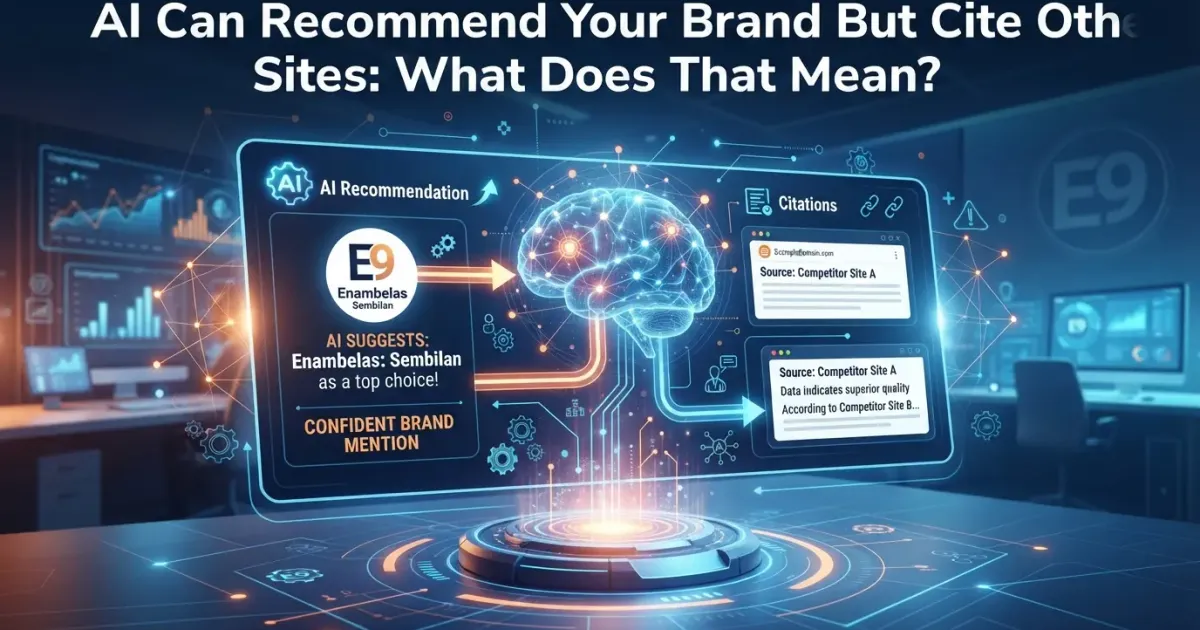
AI recommending a brand doesn't mean that brand's website will get the citation or the click. New data from Shero Commerce shows a fairly clear pattern: ChatGPT, Google AI Mode, and Perplexity can name a brand as a recommendation, while the source actually shown to the user comes from a publisher, review site, marketplace, or some other third-party domain.
This finding is covered in a Search Engine Journal report on AI recommending brands but citing other sites. Out of 1,851 sources cited across those three AI platforms, only 2.8% were pages owned by the brand itself. Meanwhile, the largest source category — including sites like Good Housekeeping, Verywell Fit, and Reviewed.com — accounted for 59% of citations.
For marketing, SEO, and e-commerce teams, the implication matters. Brand visibility and referral traffic can apparently move independently of each other. A company can "win" in an AI answer because its name gets recommended, while a different publisher walks away with the link and the click opportunity.
Table of Contents
- What Did This AI Citation Study Find?
- Why Should Brand Mentions and Citations Be Measured Separately?
- Is a Citation More Valuable Than a Brand Recommendation?
- Why Does AI More Often Cite Publishers and Review Sites?
- What's the Connection Between Duplicate Product Descriptions and AI Citation?
- Is Thin Product Description Content the Cause?
- Why Does Original Product Content Still Matter?
- How Does Google AI Mode Behave in Shero's Sample?
- What's the Impact on E-commerce Strategy in the Generative AI Era?
- How Do You Improve a Brand Website's Chances of Getting Cited?
- 1. Make the product page more informative than a standard feed
- 2. Avoid fully relying on manufacturer copy
- 3. Make important information machine-readable
- 4. Strengthen third-party evidence
- 5. Run a controlled experiment
- How Do You Measure Recommendation and Citation Separately?
- Is Third-Party Citation Always Bad for a Brand?
- What Should You Audit on Third-Party Sources?
- Should a Brand Chase Every Publisher AI Cites?
- What Are This Study's Limitations?
- FAQ About Brand Recommendation and AI Citation
- Does a brand that AI recommends automatically get a link?
- How much of AI's citations come from a brand's own website?
- Who gets cited most often?
- Does a duplicate product description cause a brand to not get cited?
- Will lengthening a product description increase AI citation?
- Does a third-party citation mean a brand's strategy failed?
- Conclusion
What Did This AI Citation Study Find?
Shero Commerce tested purchase-intent questions across 60 product categories and gathered the sources Google AI Mode, ChatGPT, and Perplexity used. The results show third-party sources dominating over a brand's own pages.
Metric | Study Result |
|---|---|
Total sources cited | 1,851 |
Citations from brand-owned pages | 2.8% |
Largest source category | 59% of all citations |
Total brand recommendations | 159 |
Brand recommendations that also cited the brand's own page | 31% |
That 31% figure means that in most cases where a brand is named as a recommendation, the source link doesn't come from that brand's own official page.
But there's an important caveat. This study shows where the citation landed, not the ranking mechanism or the technical reason one source got chosen over another. So the data doesn't prove AI is deliberately "avoiding" brand websites.
Why Should Brand Mentions and Citations Be Measured Separately?
Because the two metrics answer different questions. Brand mention measures whether a brand gets included in an AI answer. Citation measures which domain or page gets used as the source visible to the user.
In generative artificial intelligence, a system can assemble an answer from several sources at once. A model doesn't have to pull all its information about a product from that product's own manufacturer website.
For example, AI can answer:
For squat-proof leggings, a few options that often get recommended are Brand A, Brand B, and Brand C.
But the citation underneath that answer can point to an independent review article comparing all three brands.
In this situation:
- The brand gets a mention.
- The brand gets recommendation visibility.
- The publisher gets the citation.
- The publisher has a much bigger chance of getting the click.
If a dashboard only tracks brand mentions, a team could conclude performance is excellent while its own domain gets almost no referral opportunity at all.
Is a Citation More Valuable Than a Brand Recommendation?
Not always. The two serve different business functions.
A recommendation can build awareness, consideration, and preference. If AI names your product as one of the best options, the brand still gets exposure even when the link points to a different publisher.
A citation sits closer to the opportunity for a direct visit to your website. A user who opens the source will likely land on the cited domain, not automatically go looking for the brand's own site.
Outcome | Main Value |
|---|---|
Brand mention | Awareness |
Brand recommendation | Consideration |
Brand-owned citation | Authority + a referral opportunity |
Third-party citation that recommends the brand | Earned credibility, but traffic goes to a third party |
Because of that, a generative AI visibility strategy shouldn't pick just one metric. A team needs to track both.
Why Does AI More Often Cite Publishers and Review Sites?
The Shero study doesn't prove the cause. This needs to be stressed, since it's very easy to turn a correlation into a ranking claim.
But the pattern makes functional sense. For a purchase question like "which product is best?", an independent review or comparison article can offer a cross-brand perspective that isn't available on a single vendor's own product page.
An official product page usually just explains its own product's strengths. A publisher, meanwhile, can compare several alternatives on a single page.
For an AI system that needs to assemble a recommendation, that kind of source can structurally offer broader context. But again, the Shero study never tested whether this specific factor is what directly causes a publisher to receive the citation.
What's the Connection Between Duplicate Product Descriptions and AI Citation?
Shero also reviewed product content on Shopify stores. Out of 8,573 product descriptions across 883 stores with active product data, roughly 20% were found identical or very similar to text on another website.
The similarity mostly occurred among retailers or marketplaces selling the same product, not between directly competing Shopify brands.
The study's author suggests content syndication could make attribution harder, since identical text shows up across many domains. But Search Engine Journal explicitly notes that this analysis doesn't prove duplicate descriptions are the cause of third-party sites getting more citations.
This distinction matters.
The data shows two things happening at the same time:
- Brand-owned pages get very few citations.
- Some product descriptions were also found to be very similar across multiple sites.
But no experiment has proven a cause-and-effect relationship between the two.
Is Thin Product Description Content the Cause?
That can't be concluded yet. Shero found that of 173 stores measurable via clean raw HTML, 27 had fewer than 50 words of product-specific content.
But that number also has technical context. On Shopify, a short description field doesn't necessarily mean the whole product page is thin. The theme, metafields, structured content, reviews, FAQs, specifications, and other components can add information beyond the main description.
So the approach of "add 500 words to every product page so AI cites it" isn't backed by this study.
What makes more sense is making sure a product page has unique, genuinely useful information for the buyer's actual needs, rather than mechanically chasing text length.
Why Does Original Product Content Still Matter?
Even though the study hasn't proven original copy increases citation, unique content still carries real value for users and search engines.
If every retailer uses the same manufacturer description, the page becomes hard to tell apart from any other. A brand or retailer should add information it genuinely knows firsthand.
For example:
- internal testing results;
- a sizing guide based on real-world use;
- detailed materials and specifications;
- original photos;
- usage videos;
- an FAQ built from actual customer questions;
- a comparison across variants;
- compatibility information;
- shipping and return information;
- verified customer reviews.
Information like this gives a user — and potentially a retrieval system — a reason to see that page as a distinct source from every other listing.
How Does Google AI Mode Behave in Shero's Sample?
Shero reports that a brand was cited or recommended in 9.5% of relevant Google AI Mode store checks across the 60 categories tested.
In roughly a third of those categories, no sampled brand showed up at all.
But Search Engine Journal stresses an important limitation: Shero doesn't provide an equivalent recommendation rate for ChatGPT and Perplexity.
Because of that, the 9.5% figure shouldn't be used to claim "Google AI Mode recommends brands less often than ChatGPT" or any similar comparison. An equivalent dataset for making that comparison simply isn't available in the report.
What's the Impact on E-commerce Strategy in the Generative AI Era?
The biggest shift is that a team has to stop treating its own website as the only surface that determines how a brand gets presented.
In an AI recommendation journey, a user can go through a flow like:
User prompt
      ↓
AI recommends Brand A
      ↓
AI cites Publisher B
      ↓
User opens Publisher B
      ↓
Publisher compares Brand A, C, and D
      ↓
User picks a specific retailer
The brand benefits from the recommendation, but doesn't control the whole journey.
A visibility strategy ends up having two sides:
- Owned source optimization: making the brand's website worth using as a source.
- Third-party visibility: making sure the brand is represented accurately on the independent sources AI uses often.
How Do You Improve a Brand Website's Chances of Getting Cited?
There's no formula proven by the Shero study yet. Search Engine Journal explicitly states the research hasn't tested whether rewriting product content, adding original copy, or changing page structure actually increases citation.
So the strategies below should be treated as reasonable areas for experimentation, not confirmed AI ranking factors.
1. Make the product page more informative than a standard feed
Add information that isn't easy to find on other retailers: real-world usage data, compatibility, specifications, variant comparisons, an FAQ, and other genuinely useful detail.
2. Avoid fully relying on manufacturer copy
If a product description is identical across many websites, the page has little informational differentiation.
3. Make important information machine-readable
Structured data, semantic HTML, clear headings, specification tables, and product-variant relationships can all help a system understand the page's information structure.
4. Strengthen third-party evidence
If publishers and review sites often get the citation, a brand's presence there becomes part of the AI visibility strategy.
5. Run a controlled experiment
Pick a group of product pages, change one factor such as uniqueness or information depth, and then measure whether citation behavior changes after a set period.
Without an experiment, a team is just changing content based on assumption.
How Do You Measure Recommendation and Citation Separately?
An AI visibility dashboard should have at least four fields:
Metric | Example |
|---|---|
Brand Mentioned | Yes |
Brand Recommended | Yes |
Brand Domain Cited | No |
Third-Party Domain Cited | PublisherX.com |
With a model like this, a team can identify four distinct conditions:
- The brand is recommended and its own domain is cited.
- The brand is recommended but a third party is cited.
- The brand is mentioned without a recommendation.
- The brand doesn't show up at all.
Each one calls for a different strategy.
If your team has already covered measuring visibility on ChatGPT, Gemini, or Perplexity, the internal article ChatGPT Can Now Search Specific Subreddits: What It Means for Generative AI can serve as an internal link once the previous article's URL is verified.
Is Third-Party Citation Always Bad for a Brand?
No. A citation to a third party can carry independent validation that's actually hard to get from the brand's own website.
If a trusted publisher recommends a product and AI cites that publisher, the brand gets a form of earned authority.
The problem is that the company loses some control over:
- the landing page;
- the messaging;
- the conversion path;
- pricing information;
- which products get compared;
- the affiliate link;
- which retailer ultimately gets the sale.
So the goal of the strategy isn't eliminating every third-party citation. What makes more sense is improving the balance: the brand keeps earned visibility beyond its own domain while making its owned pages strong enough to be a viable source too.
What Should You Audit on Third-Party Sources?
Start with the domains that get cited most often for high-value prompts.
- Log which publishers show up.
- Look at the specific page being cited.
- Check how the brand is being described.
- Verify whether the pricing and feature information is still accurate.
- Identify which competitors show up alongside the brand.
- Check whether the link goes to the brand, a marketplace, or an affiliate retailer.
- Prioritize the sources with the highest visibility.
An audit like this turns AI visibility from a bare metric into an actual map of information distribution.
Should a Brand Chase Every Publisher AI Cites?
No. Prioritize based on relevance, authority, citation frequency, and commercial intent.
A citation from a publisher that shows up across dozens of high-intent prompts is far more strategic than a single citation on a prompt that's barely related to a purchase.
A team also has to preserve editorial independence. The goal isn't manipulating reviews or asking a publisher to fake a recommendation. What can be done is making sure factual information — like specifications, availability, pricing model, and the latest features — is easy to verify.
What Are This Study's Limitations?
Shero's dataset offers useful insight, but it shouldn't be generalized without context.
- The study focuses on e-commerce and Shopify stores.
- Testing covered 60 product categories.
- The platforms tested were Google AI Mode, ChatGPT, and Perplexity.
- The study shows citation outcomes, not the citation-selection algorithm.
- Duplicate descriptions were found, but a causal link to citation wasn't proven.
- Content changes haven't been tested to see if they can increase citation.
- Cross-platform recommendation rates aren't available in an equivalent format.
In other words, the headline "AI prefers publishers over brands" describes a pattern in the dataset, but it doesn't yet explain the mechanism causing that pattern.
FAQ About Brand Recommendation and AI Citation
Does a brand that AI recommends automatically get a link?
No. In the Shero study, the brand's own page was cited in only 31% of the 159 cases where the brand was recommended.
How much of AI's citations come from a brand's own website?
Across the sample of 1,851 citations from Google AI Mode, ChatGPT, and Perplexity, brand-owned pages contributed only 2.8%.
Who gets cited most often?
The largest category is third-party sites like publishers and review sites, which made up 59% of citations in the study.
Does a duplicate product description cause a brand to not get cited?
Not proven yet. Shero found around 20% of product descriptions identical or very similar to another website's, but the study didn't test a causal link between duplication and citation.
Will lengthening a product description increase AI citation?
There's no evidence from this study either way. Search Engine Journal states that changes like a rewrite, original copy, or page-structure changes would need to be tested specifically to know their impact.
Does a third-party citation mean a brand's strategy failed?
No. A third-party citation can provide independent validation. But a team needs to measure whether the brand is getting recommended and whether its own domain is getting a referral opportunity.
Conclusion
AI recommending a brand and AI citing that brand's website are two different outcomes. Shero Commerce's data shows a substantial gap: only 2.8% of 1,851 citations came from brand-owned pages, and when a brand was recommended, its own page was also cited in only 31% of cases.
This finding doesn't prove why AI chooses a publisher or third-party site. Duplicate product content and thin descriptions both showed up in the dataset, but haven't been tested as a direct cause.
For generative AI, SEO, and e-commerce teams, the more mature strategy is tracking mentions, recommendations, and citations separately. Optimize owned pages to carry unique, clear information, but don't ignore the third-party sources that turn out to be common evidence for AI.
If your business wants to build an AI citation monitoring system, a brand visibility audit, a content architecture, or an e-commerce pipeline better prepared for generative search, you can discuss your business's technology needs with our technical team.



Comments
Got a question or feedback? Leave a comment!