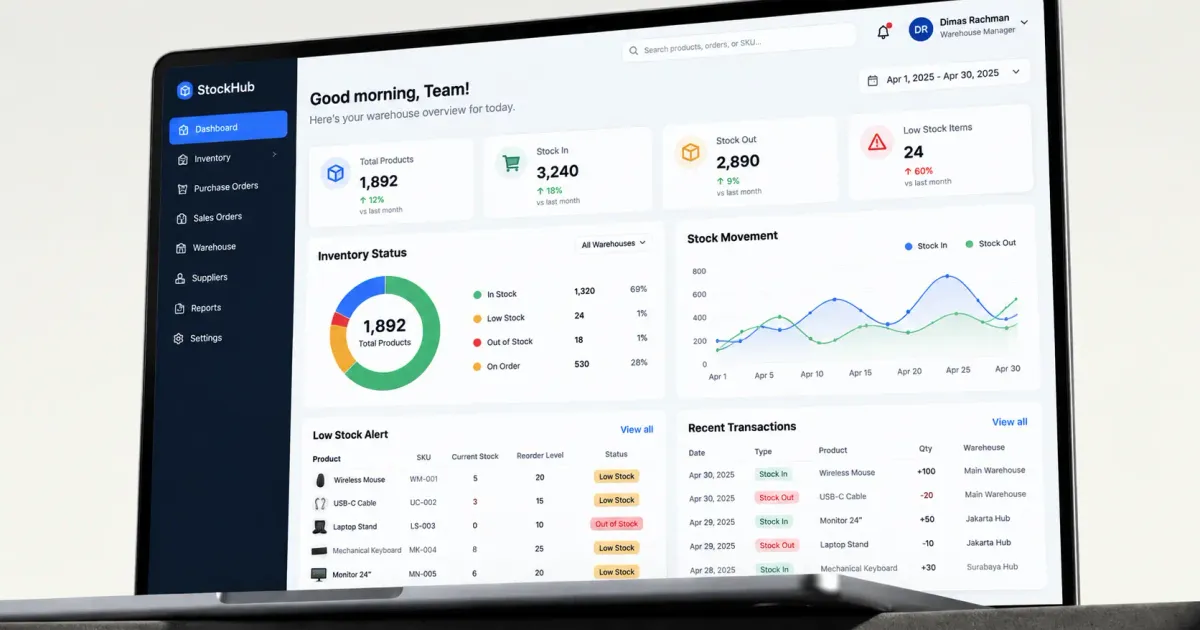
Running out of stock isn't just about losing one sale — the impact is often bigger than that. A customer who came specifically for one product and leaves empty-handed has a good chance of never coming back, and the cost of that lost trust is far more expensive than the value of one missed transaction. This article covers warehouse and inventory management systems — how they work, and why so many businesses run out of stock 'without noticing' even though they already record stock regularly.
This is part of our complete guide to ERP, CRM, and business management systems.
Table of Contents
- Why 'Already Recording Stock' Isn't Necessarily Enough
- Core Features of a Good Warehouse Management System
- Data: The Real Impact of Poor Stock Management
- Different Needs Based on Business Scale and Location
- How Reorder Points Work: A Simple Calculation Example
- A Stock Classification Method: ABC Analysis
- Physical Warehouse Management vs Digital Stock Management
- Common Mistakes in Warehouse Management
- The Connection to POS and ERP Systems
- The Hidden Costs of Poor Stock Management
- The Role of Demand Forecasting
- Frequently Asked Questions
- How often should a physical stock count be done?
- Does a small business with few products still need a warehouse management system?
- Can a warehouse management system prevent theft or stock leakage?
- If Your Warehouse Needs Are Fairly Complex
Why 'Already Recording Stock' Isn't Necessarily Enough
Many businesses already record stock — whether in a notebook, a spreadsheet, or a simple POS app. The problem is, passive stock recording (just noting it down, never analyzed) is very different from active warehouse management — a system that actually warns you before stock runs out, instead of just recording the number after it already happened.
A mature warehouse management system doesn't just answer 'how much stock is there now', but also 'when should we restock', 'which products turn over fastest', and 'how much capital is sitting idle in stock that rarely sells'.
Core Features of a Good Warehouse Management System
- Automatic reorder points — the system warns you once stock hits a certain threshold, calculated based on average sales velocity and supplier delivery time.
- Multi-location tracking — for a business with more than one warehouse/branch, stock visibility across all locations in one dashboard.
- Inventory turnover analysis — identifying products that sell quickly vs those that pile up for a long time, helping restock and discount decisions.
- Supplier and purchase order management — recording purchase history from each supplier, including average delivery time for more accurate planning.
- Batch/serial number tracking — important for products with an expiry date or specific traceability requirements.
Data: The Real Impact of Poor Stock Management
Poor stock management isn't just anecdotal. Data from the Ministry of Cooperatives and SMEs shows that out of roughly 64.2 million MSME units in Indonesia, only around 25.5 million had integrated into the digital ecosystem as of mid-2024 — and manual stock recording disconnected from the sales system is one of the most common weak points among the majority of businesses that haven't made that switch yet. On the other hand, Bank Indonesia recorded that 1,655 MSMEs actively transacting through digital channels saw revenue grow 29.9% year-on-year during the 2025 Karya Kreatif Indonesia period, showing a correlation between a more structured system (including stock management) and better business performance.
Different Needs Based on Business Scale and Location
A business in a big city with easy access to many suppliers can usually run a leaner (just-in-time) stock strategy, since replenishment is fast and doesn't need a big buffer stock. A business in an area with more limited distribution access — say, a store outside Java where delivery from suppliers can take longer — usually needs a bigger stock buffer and a restock alert triggered earlier, to account for a longer delivery lead time.
This is one reason why a 'reorder point' calculated automatically by the system is far more useful than a generic benchmark figure — a good system adjusts the threshold based on the sales velocity and delivery time specific to each product and location, not the same flat number for every situation.
How Reorder Points Work: A Simple Calculation Example
For example, product A sells an average of 10 units per day, and delivery from the supplier takes 5 days. The reorder point should ideally be set at 50 units (10 x 5) plus an extra safety buffer (say, 20 units) to account for sudden demand spikes — so the final reorder point ends up around 70 units. Once stock reaches this number, the system automatically warns you to reorder, well before stock actually runs out.
Good warehouse management isn't about having a lot of stock — it's about having the right stock, at the right time.
A Stock Classification Method: ABC Analysis
One of the most practical methods for prioritizing attention in warehouse management is ABC analysis — grouping products by their contribution to sales value. Category A is the 20% of products contributing about 80% of sales value — these need the closest monitoring since running out of them has the biggest impact. Category B is products with a medium contribution, and category C is the majority of products with a small per-item contribution despite their large number.
With this classification, a business can allocate time and attention proportionally — more frequent physical stock counts for category A, while category C can be checked less often with no major risk. This is far more efficient than treating every product with the same level of attention, which usually ends up wasting time on insignificant products while important ones go under-monitored.
Physical Warehouse Management vs Digital Stock Management
It's important to distinguish: physical warehouse management (layout, storage system, in-and-out flow of goods) and digital stock management (recording and analyzing data) are two complementary but distinct things. Even the most sophisticated digital system won't be effective if the physical warehouse layout is a mess — items are hard to find, there's no clear shelf-location system, or old items get buried under new ones.
The ideal combination: an organized physical layout (for example, a FIFO system — first in, first out — for products with an expiry date) paired with a digital system that accurately reflects that physical location. Without this alignment, warehouse staff will waste valuable time searching for an item the system says 'is there', but no one actually knows which shelf it's on.
Common Mistakes in Warehouse Management
- Keeping too much stock 'just in case' with no real calculation, tying up capital that could be used for other things.
- Not doing routine physical stock counts, so the numbers in the system drift further and further from reality over time.
- Ignoring slow-moving products, letting capital sit 'dead' in stock that rarely sells for years.
- A reorder point that never gets adjusted even as a product's sales pattern changes over time (for example, seasonal products).
The Connection to POS and ERP Systems
Warehouse management is most effective when integrated with the sales system — once a transaction happens in a POS app, stock automatically decreases without a separate manual update. For a larger-scale business, warehouse management usually becomes one module within a broader ERP system, also connected to financial and production data.
For a concrete illustration of how a system like this is designed, we have examples of multi-outlet inventory management for F&B businesses and manufacturing inventory and production management.
The Hidden Costs of Poor Stock Management
Beyond the direct lost sales from running out of stock, there are a few other hidden costs business owners often don't realize. Excess stock ties up working capital that could be used elsewhere (expansion, marketing, extra salaries) — capital 'sleeping' in the warehouse produces nothing until that product sells. For products with an expiry date, excess stock that doesn't sell in time means a total loss, not just idle capital.
There's also the cost of storage itself — warehouse space, electricity for cooling (if the product needs special storage), and the labor time to manage excess stock. These costs are rarely counted explicitly in a simple financial report, even though the total can be significant if stock management stays suboptimal over the long run.
The Role of Demand Forecasting
A more mature warehouse management system isn't just reactive (waiting for stock to run low before acting), but also proactive through demand forecasting — estimating stock needs based on historical patterns, seasonality, or current trends. For example, a product that historically always sells like crazy ahead of a holiday can have its stock planned well in advance, instead of waiting until demand actually spikes.
This forecasting doesn't need to be complex at first — even a simple analysis of last year's sales data for the same period is already far more helpful than no planning at all. A system that keeps historical sales data well-organized is the basic prerequisite for effective forecasting like this.
Frequently Asked Questions
How often should a physical stock count be done?
For a business with high stock turnover, ideally monthly. For a business with more stable stock, quarterly is usually enough. What matters is consistency, not just doing it occasionally when a discrepancy is suspected.
Does a small business with few products still need a warehouse management system?
If the number of products is still very small (under 20 items) and easy to monitor manually, it might not be urgent yet. Once the number of products grows or there's more than one storage location, a more structured system starts providing real benefits.
Can a warehouse management system prevent theft or stock leakage?
It helps indirectly — with more detailed tracking and an audit trail of who changed what data, stock discrepancies become easier to trace back to their source compared to manual recording with no clear trail.
If Your Warehouse Needs Are Fairly Complex
For a business with complex warehouse management needs — multi-location, deep supplier integration, or specific traceability requirements — our team at Altive Dev can help design a custom inventory management system. Tell us about your needs, and we'll help map out the solution.



Comments
Got a question or feedback? Leave a comment!